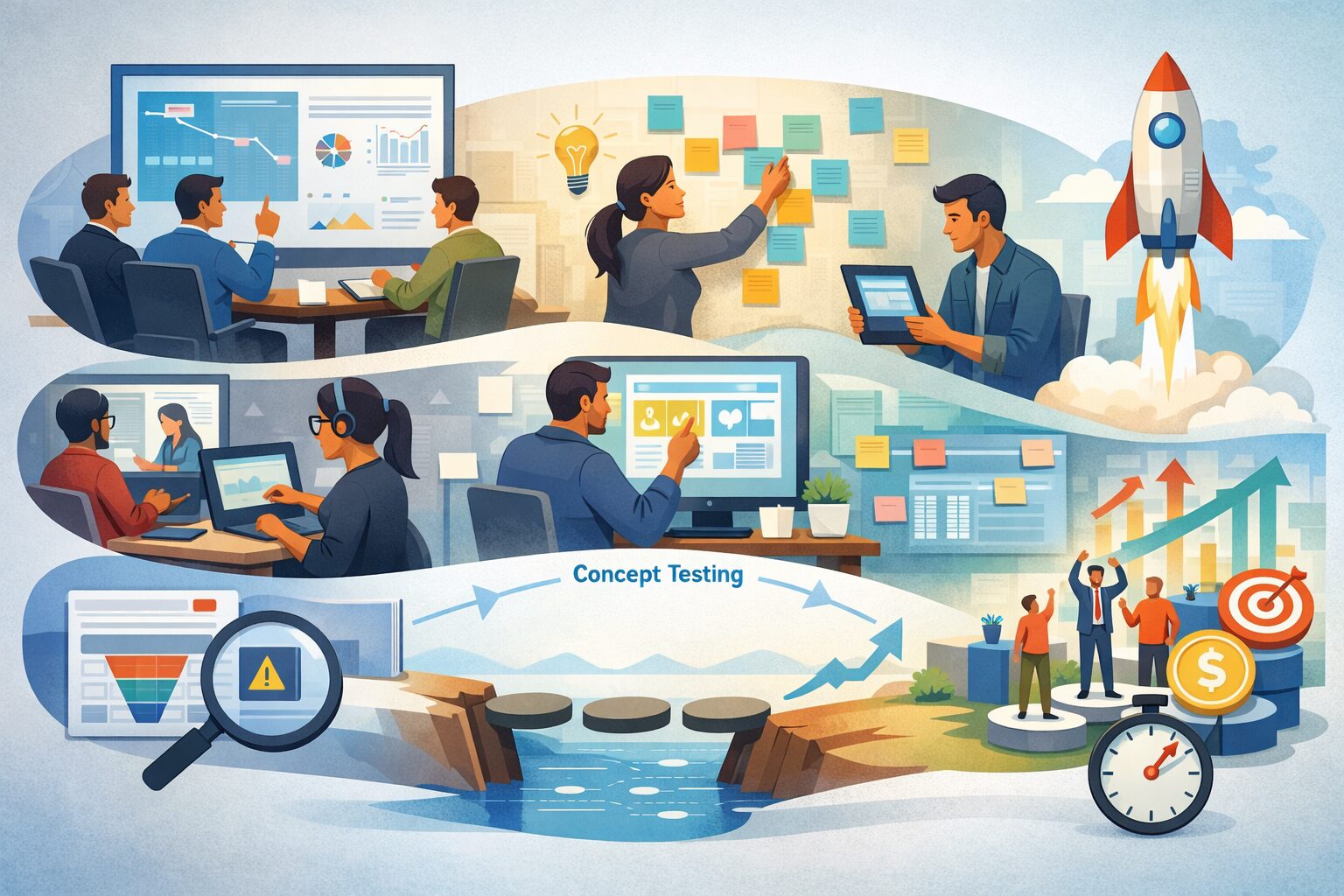




Corporate growth stalls when leaders confuse invention with market adoption. You can pour millions into a research and development lab, launch new digital features every quarter, and still lose market share to agile disruptors. Invention generates ideas; adoption generates revenue. Closing the gap between the two requires a systemic, repeatable approach to ambiguity. This is where design thinking for innovation transitions from a buzzword into a critical business operations framework.
Design thinking is a powerful tool for solving complex problems because it fundamentally shifts how organizations allocate capital and manage risk. It forces teams to anchor every strategic initiative in verified market reality before writing a single line of code or launching a new product line. By prioritizing rapid market validation over internal assumptions, executives can deploy resources with precision.
As MENA’s first UX design and innovation agency, webkeyz has watched legacy enterprises struggle to modernize. Government mandates across Riyadh and Dubai demand aggressive digital transformation, yet many traditional banks, telecoms, and healthcare providers remain paralyzed by outdated execution models. They build robust delivery pipelines but fail to ask if they are building the right product in the first place.
Here is how you can apply design thinking for innovation to tackle challenges in real-world projects, dismantle organizational silos, and engineer predictable revenue growth.
The High Cost of Misunderstanding Design Thinking for Innovation
Executives often relegate design to the final stage of product development. They treat it as the aesthetic layer applied just before launch. This fundamental misunderstanding guarantees capital waste. When you isolate design from core business strategy, you build highly polished products that solve no actual market need.
Design thinking for innovation is not an aesthetic practice; it is a rigorous risk-mitigation strategy. At its core, it prevents the enterprise from funding spectacular failures. Every complex corporate problem—from entering a new market segment to reversing customer churn—carries immense financial risk. The traditional corporate approach attempts to mitigate this risk through massive spreadsheets, prolonged feasibility studies, and internal consensus. By the time a product ships, the market has moved on.
Relying on internal consensus creates an illusion of safety. Teams assume that because a steering committee approved a multi-million dollar budget, the market will naturally accept the output. This is a lethal assumption. Design thinking for innovation replaces the illusion of safety with actual market evidence. It forces organizations to test their riskiest assumptions early, cheaply, and frequently.
The financial stakes are absolute. A product failure late in the development cycle costs exponentially more than a prototype failure in week two. By embedding design thinking for innovation at the executive level, you transition your organization from a culture that fears failure to a culture that monetizes rapid learning. You stop asking “Can we build this?” and start answering “Should we build this, and will they pay for it?”
Why Legacy Corporate Structures Stifle Design Thinking for Innovation
If the methodology is proven, the failure point lies in the organizational architecture. Enterprise structures are inherently hostile to ambiguity. Legacy corporations operate on linear, predictive models. They want fixed budgets, fixed timelines, and guaranteed outcomes. Design thinking for innovation requires dynamic iteration, cross-functional collaboration, and a willingness to pivot based on user evidence. These two operational models constantly collide.
The problem persists because middle management is incentivized to hit delivery dates, not to solve complex problems. When a project manager’s bonus depends on launching a feature by Q3, any market research that suggests pivoting the feature is viewed as a threat, not an insight. The corporate immune system attacks the very processes required to innovate.
Furthermore, traditional business units operate in aggressive silos. Marketing owns the customer acquisition, product owns the features, engineering owns the code, and customer support owns the fallout. Design thinking for innovation demands that these disciplines merge to tackle challenges in real-world projects collaboratively. When silos remain intact, innovation becomes impossible, and the customer experience fractures along organizational fault lines.
The MENA Hierarchy Trap and Design Thinking for Innovation
Regional business culture adds a layer of complexity. In the MENA region, hierarchical leadership structures often suppress the foundational requirement of design thinking: psychological safety. Innovation requires teams to challenge assumptions, present contrary evidence, and occasionally tell a CEO that their pet project lacks market viability.
When organizations operate on rigid, top-down directives, employees optimize for obedience rather than market truth. They execute flawed visions flawlessly. Overcoming this requires more than just introducing a new methodology; it requires deliberate structural intervention. Executives must explicitly decouple discovering the truth from insubordination. When leaders actively demand evidence over compliance, design thinking for innovation finally gains the traction needed to drive real business outcomes.
How to Operationalize Design Thinking for Innovation in Complex Portfolios
Understanding the methodology is useless without an operational deployment strategy. You cannot mandate innovation through a corporate memo. To drive actual value, leaders must embed design thinking for innovation directly into the enterprise funding and governance models.
This begins by altering how projects are initiated. Instead of funding a 12-month development cycle based on a speculative business case, executives must fund the discovery phase. You allocate a fraction of the budget to define the actual problem, build a prototype, and validate it with real users. Only when the prototype demonstrates measurable market traction do you release the capital for full-scale development.
By deploying structured Innovation Programs, enterprises can systemicize this approach. This ensures that tackling challenges in real-world projects is not left to chance or isolated to a single rogue team. It creates a standardized pipeline where every new initiative must survive market validation before consuming serious capital.
Deploying Design Thinking for Innovation in Real-World Projects
The transition from theory to practice requires enforcing three non-negotiable operational shifts across your product teams. First, teams must redefine the business problem from the customer’s perspective. A bank’s problem might be “we need to increase mortgage applications by 20%.” The customer’s problem is “buying a house is terrifying and opaque.” Design thinking for innovation bridges this gap. By solving the customer’s emotional and practical friction, the bank naturally hits its acquisition target.
Second, teams must radically compress their time-to-market for initial concepts. If it takes your enterprise six months to test a new idea, you are not innovating; you are institutionalizing delay. Rapid prototyping must become the default language of the boardroom. Executives should refuse to review abstract slide decks and demand to interact with clickable prototypes backed by user data.
A Structural Framework for Design Thinking for Innovation
To institutionalize these shifts, organizations must adopt a clear, measurable framework. Every initiative must pass through these distinct validation gates:
1. Problem Alignment: Cross-functional teams define the measurable business objective and identify the specific customer friction preventing that objective.
2. Assumption Mapping: Teams list the core assumptions required for the project to succeed. They isolate the highest-risk assumptions—the ones that will kill the project if proven false.
3. Rapid Prototyping: Designers build low-fidelity artifacts that simulate the solution. These are not functioning products; they are behavioral traps designed to capture user reactions.
4. Market Validation: Teams test prototypes with actual end-users. They measure behavior, not opinions. If a user says they love a feature but cannot navigate the prototype to find it, the feature fails.
5. Capital Release: Leadership reviews the validation data. Based on empirical evidence, they either pivot the concept, kill the initiative to save resources, or fund the next stage of development.
This structural approach turns design thinking for innovation into an auditable, repeatable business process that directly impacts the bottom line.
Tangible ROI: Measuring the Business Impact of Design Thinking for Innovation
Executives demand metrics. If a process cannot be quantified, it will not survive the next budget cycle. The return on investment for design thinking for innovation is no longer theoretical; it is heavily documented and starkly visible in market performance.
According to research from McKinsey, companies that excel at design grow revenues and shareholder returns at nearly twice the rate of their industry peers. This is not achieved by making products look better; it is achieved by integrating design principles into the core strategic planning of the business. When design thinking aligns with executive strategy, the enterprise moves faster and wastes less.
The financial impact manifests across three distinct operational areas. First, it drastically reduces development waste. Building software is expensive. Building the wrong software and then attempting to fix it post-launch destroys profit margins. By validating concepts before coding, enterprises eliminate redundant engineering cycles. A study by Harvard Business Review highlights that design thinking acts as a structured process that mitigates human biases—biases that historically lead executives to fund doomed projects.
Second, it accelerates time-to-market. While the initial discovery phase may feel like a delay to action-biased managers, it prevents the massive, chaotic rework that plagues traditional project launches. When developers receive validated prototypes and clear user journeys, their velocity increases exponentially.
Third, it drives customer retention. In highly commoditized markets like banking, telecommunications, and retail, the product itself is rarely a differentiator. The experience of using the product is the only remaining competitive moat. When you use design thinking for innovation to strip away friction and deliver precise value, switching costs become psychological. Customers stay because the alternative feels too difficult.
What Leadership Must Do Next to Scale Design Thinking for Innovation
Transforming a legacy enterprise cannot happen from the bottom up. Frontline workers cannot restructure corporate governance. To scale design thinking for innovation, executive leadership must take decisive, systemic action. You cannot buy a methodology; you must engineer an environment where it can survive.
Start by auditing your current portfolio. Look at the strategic initiatives slated for the next twelve months. Identify the projects with the highest capital allocation and the lowest market validation. Pause them. Force the respective teams to run a rigorous validation sprint before allowing further development. This immediate intervention demonstrates executive intent and stops financial bleed.
Next, you must invest in structural capability. Equipping your teams with the right frameworks requires expert intervention. Engaging in Innovation Training & Coaching provides your internal leaders with the exact mechanics needed to facilitate this shift, moving them from order-takers to strategic problem solvers. You must teach your product managers, engineers, and marketers how to collaborate effectively under the pressure of real-world constraints.
Finally, change what you measure. If you continue to reward teams solely for shipping on time and under budget, you will continue to get mediocre products delivered efficiently. You must begin measuring the speed of learning, the reduction of risk, and the impact of the final product on customer behavior.
The market does not reward intention; it rewards execution. The organizations that dominate the next decade will not be the ones with the largest budgets; they will be the ones with the most reliable systems for navigating ambiguity. If you are ready to stop guessing, eliminate capital waste, and build products your market actually demands, reach out to webkeyz to discuss your next strategic move.