



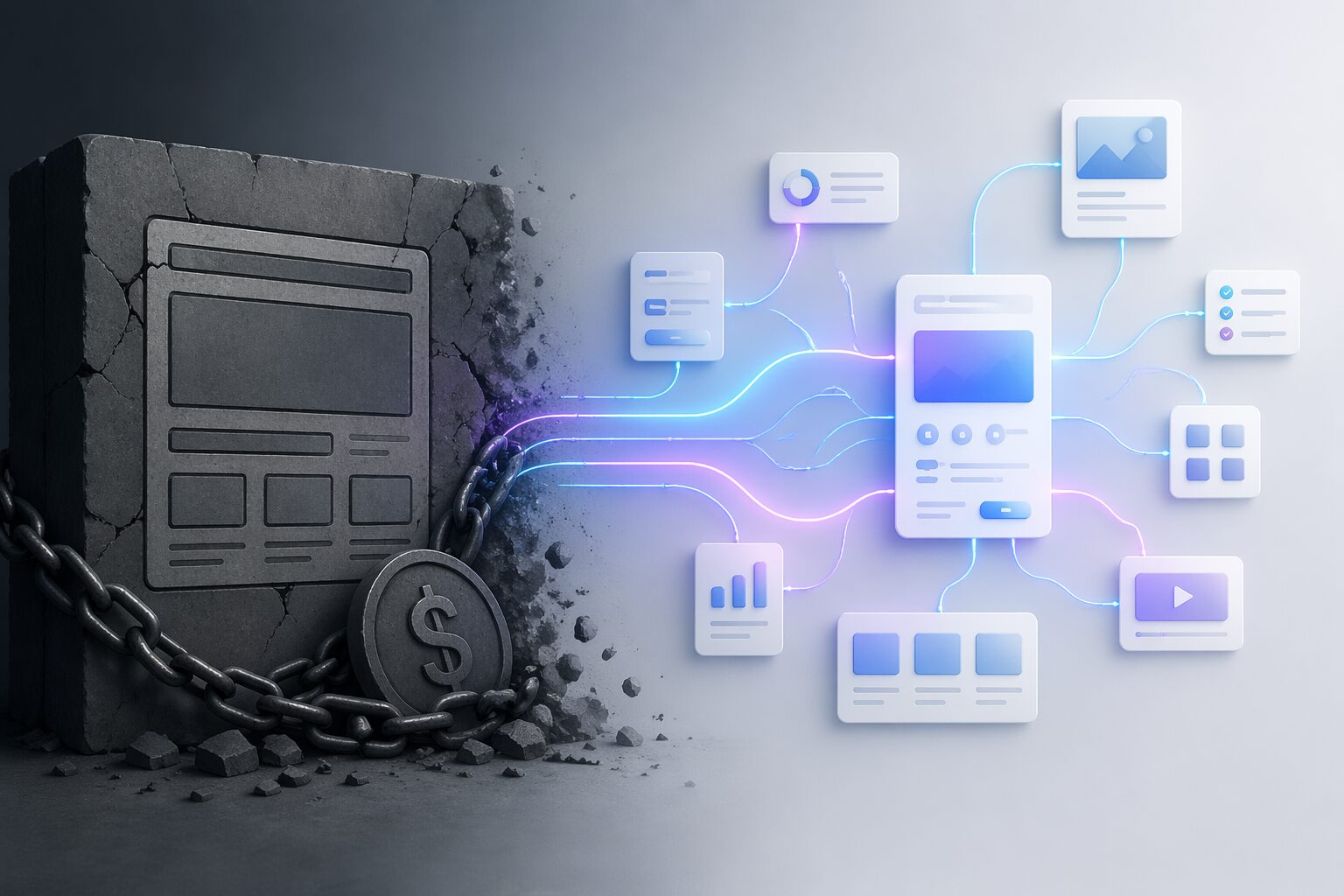
Executives routinely approve software investments based on illusions. You sit in a boardroom, review a series of polished static screens, and authorize millions in development capital. Months later, the delivered application feels disjointed, user adoption stalls, and engineering requests additional budget for extensive rework. The failure did not occur in the coding phase, nor did it happen in the visual design phase. The failure occurred because your team used static documentation to define a highly dynamic digital environment, completely missing the contextual realities of how users interact with the system.
This disconnect represents a massive operational vulnerability for enterprise software delivery. In the UX field, wireframes remain a common deliverable to show page-level layout ideas, whereas flowcharts are utilized for documenting complex workflows and user tasks. Yet, despite their widespread adoption, relying strictly on these isolated artifacts creates a critical communication gap between product vision and engineering execution. When designers hand off flat screens and business analysts hand off abstract flowcharts, the actual mechanics of the user experience are left to the assumptions of developers.
Modern digital products require modern specification formats to capture their true complexity. This is where wireflows enter the executive conversation as a non-negotiable standard. By demanding that your product teams adopt wireflows, you eliminate the ambiguity that causes development delays and user friction. You force alignment between what the business logic dictates and what the user interface actively displays at every micro-step of a transaction. For leaders focused on market speed and capital efficiency, mastering this methodology is the difference between launching a market-defining product and funding a bloated IT failure.
The Financial Risk of Static Artifacts: Why Wireflows Prevent Executive Blind Spots
The fundamental problem with legacy design documentation is its inability to capture the reality of modern software architecture. Decades ago, websites functioned as a series of linked, static documents. A wireframe of a web page conveys layout ideas, content, and page-level design for websites and apps that have few, mostly static pages, but is not as useful in communicating heavily dynamic process flows. Today, applications operate as continuous, state-driven environments. Users do not navigate from page to page; they manipulate data within a single interface, triggering modals, dynamic data loads, and localized state changes.
When your teams document these modern applications using isolated wireframes, they strip away the behavioral context. You see the starting point and the ending point, but the crucial transition states vanish entirely. Conversely, when your teams rely solely on standard flowcharts to map business logic, they abstract the interface out of existence. Using flowcharts as the main deliverable to document and ideate the interaction design involved in multistep user tasks can lose sight of the information that is shown contextually on the page and that influences the success of the interaction. Developers are forced to guess how a flowchart decision translates into a specific UI component, leading directly to costly rework cycles.
This risk is magnified exponentially in the MENA region, where digital adoption bypasses legacy desktop phases entirely in favor of mobile-first and super-app ecosystems. Consumers in Riyadh, Dubai, and Cairo expect seamless, instantaneous transactional experiences that rival the most sophisticated global platforms. If your banking application or retail platform relies on disjointed design specifications, the resulting user friction will immediately drive your customers to agile competitors. Wireflows eliminate this regional execution risk by forcing teams to visually map exactly how an interface behaves during every single business logic shift.
How Wireflow Documentation Mitigates Risk in Dynamic Applications
Wireflows specifically address the architectural shift toward asynchronous data loading and single-page applications. Many modern webapps and mobile apps have few overall pages but change the content and layout dynamically through AJAX or other advanced frontend technologies based on interactions the user has with the product. A static wireframe cannot capture a state change where merely a single localized module updates while the rest of the screen remains fixed. By deploying wireflows, you visually lock down these dynamic transitions, ensuring that engineering builds exactly the contextual experience your designers intended.
The Legacy Tooling Trap Hiding the Need for Interactive Wireflows
Organizational inertia remains the primary reason product development teams resist upgrading their methodology. Large enterprises often operate with deeply entrenched silos. Business analysts own the process logic, diligently mapping out standard flowcharts in isolation. UX designers own the interface, delivering pixel-perfect static wireframes that ignore underlying technical constraints. This division of labor creates an artificial separation between the user interface and the business logic, blinding leadership to the reality that these two elements are entirely inseparable in the final product.
When executives fail to mandate integrated deliverables, teams default to what they know. The result is a fractured development pipeline where errors are not discovered until the quality assurance phase, or worse, after deployment. According to McKinsey, companies that break down functional silos and deeply integrate design with engineering consistently capture significantly higher revenue growth and shareholder returns than their industry peers. Continuing to tolerate disconnected flowcharts and static wireframes actively sabotages your organization’s ability to achieve these financial benchmarks.
Breaking this legacy tooling trap requires a fundamental shift in how leadership defines a complete product specification. You must stop accepting design artifacts that require secondary explanations or assumptions to understand. Wireflows compel cross-functional teams to confront the reality of the application together, long before a single line of code is written. They expose the awkward transitions, the missing error states, and the illogical user journeys that isolated flowcharts and static screens effortlessly conceal.
Overcoming Internal Resistance to Cross-Functional Wireflow Integration
Product managers frequently argue that generating detailed wireflows requires too much time upfront, slowing down agile sprints. This argument represents a fundamental misunderstanding of development economics. The time spent resolving ambiguity during the engineering phase costs exponentially more than the time invested in accurate specification during the design phase. By forcing teams to utilize wireflows, you shift the cognitive load back to the ideation stage where making changes costs almost nothing, systematically protecting your engineering budget from preventable bloat.
Operationalizing Wireflows to Align Business Logic with User Interface Context
To scale digital execution across an enterprise, leadership must establish strict definitions and operational standards for product deliverables. Wireflows are a design-specification format that combines wireframe-style page layout designs with a simplified flowchart-like way of representing interactions. They emerged as a common practice among teams designing mobile apps, where each step in the flowchart is represented by a wireframe for a full mobile-screen design. This hybrid approach provides developers with immediate, contextual clarity, showing them exactly what the user sees at the exact moment a specific logical decision is required.
Implementing this standard requires updating your operational playbook. You must train product owners, designers, and engineers to utilize wireflows as their primary language for complex functionality. Wireflows are also incredibly useful as a collaboration and ideation technique for teams to think through user workflows and tasks and to ideate screen designs at each step in the process. When stakeholders gather around a wireflow, they are no longer debating abstract logic or isolated aesthetics; they are evaluating the holistic reality of the digital experience.
As MENA’s first UX design and innovation agency, webkeyz integrates this methodology deeply into our engagements. When engineering intricate enterprise portals or consumer fintech platforms, mapping the interaction logic through rigorous Digital Experience frameworks ensures nothing is left to interpretation. While wireflows excel at showing task flows on apps and dynamic websites where the content or layout on each page changes based on user interactions, they can also be highly suitable for documenting task flows in traditional static websites, proving their versatility across your entire digital portfolio.
Deploying Wireflows for Complex Mobile and Desktop Workflows
While initially popularized by mobile-first methodologies, the utility of this specification format extends far beyond the smartphone screen. Wireflows are not merely limited to documenting mobile apps and websites; they can also be successfully used for desktop products, typically by showing a portion of a screen or webpage that changes based on user interactions. Whether your team is designing a dense enterprise resource planning dashboard or a responsive consumer portal, mapping the localized state changes via wireflows guarantees that the structural integrity of the application holds up under complex user demands.
Structuring Your Wireflow Pipeline for Super-App Architecture
The rise of the super-app in the MENA region demands unprecedented levels of architectural precision. When an application integrates ride-hailing, food delivery, and financial services into a single interface, the density of dynamic state changes becomes staggering. Deploying wireflows in this environment is not optional; it is the only viable method for documenting how distinct micro-services overlap and interact within the same screen. Leadership must mandate that every new feature module integrated into a super-app ecosystem is mapped via comprehensive wireflows prior to executive approval.
Quantifying the Business Impact of Wireflows in Enterprise Software Delivery
Adopting a new documentation standard must deliver measurable business outcomes, and the financial impact of wireflows is realized primarily through risk mitigation and accelerated delivery timelines. When developers receive a specification that visually unites the layout with the logical flow, the volume of clarifying meetings, Slack threads, and Jira tickets plummets. This operational clarity allows engineering teams to maintain their velocity, directly reducing the time-to-market for critical digital initiatives.
The cost of ignoring this alignment is severe. Research from Nielsen Norman Group identifies wireflows as a critical emerging UX deliverable precisely because traditional methods fail to document complex interactions accurately, leading to systemic development failures. When an engineering team builds a dynamic state based on a flawed interpretation of a standard flowchart, the business incurs the cost of the initial development, the cost of identifying the error, the cost of the redesign, and the cost of the technical rework. Wireflows short-circuit this cycle of waste by forcing total clarity before development begins.
Furthermore, accurate interaction mapping directly impacts post-launch user retention. In aggressive markets like Saudi Arabia and the UAE, user tolerance for clunky, disjointed digital experiences is virtually zero. If an application’s dynamic states feel unnatural because the developer had to guess the intended transition between two static screens, the user will abandon the transaction. By utilizing wireflows to perfect these interaction details during the ideation phase, you actively protect your customer acquisition investments and secure long-term digital revenue streams.
Validating Wireflow Efficiency Through Market Benchmarks
Organizations that successfully transition to integrated design specifications report a drastic reduction in quality assurance bottlenecks. Because the wireflow acts as a definitive blueprint for both the interface and the interaction logic, QA teams can write far more accurate test cases prior to the completion of the code. This parallel processing accelerates the entire release cycle, allowing your enterprise to respond to market shifts and deploy revenue-generating features faster than competitors still struggling with fragmented documentation.
Executive Directives for Mandating Wireflows in Future Product Roadmaps
Transitioning an enterprise to a wireflow-centric development model requires decisive executive action, not mere suggestions to the design department. You must rewrite the criteria for funding and approving digital projects. If a product owner brings a proposal to the boardroom supported only by isolated static screens and disconnected process diagrams, reject it. Demand that all dynamic applications, complex workflows, and state-driven interfaces be documented and validated through comprehensive wireflows before releasing any engineering budget.
This mandate forces your siloed departments into immediate collaboration. Business analysts will have to sit directly with UX designers to ensure their process logic aligns perfectly with the spatial realities of the interface. Engineers will gain the confidence that the specifications they receive are actionable, accurate, and final. By institutionalizing wireflows, you elevate the UX discipline from a localized production task into a strategic operational advantage that safeguards your software investments.
The complexity of digital transformation in the MENA market requires sophisticated methodologies that eliminate execution risk. Standardizing your approach to interaction design ensures that the vision you approve in the boardroom is the exact reality your customers experience in the market. Lead your organization away from legacy documentation and demand the precision that modern digital products require.
To discuss integrating rigorous design specifications into your digital delivery pipeline, contact our leadership team directly.