


Most executives view a Corporate Identity (CI) manual as a delivery requirement a static PDF handed over at the end of a branding project, filed away on a server, and rarely opened. This is a fundamental error in asset management.
A brand is likely the most valuable intangible asset on your balance sheet. In a fragmented media landscape, where your company interacts with customers across dozens of touchpoints from mobile apps in Dubai to billboards in Riyadh inconsistency is not an aesthetic annoyance. It is a financial leak.
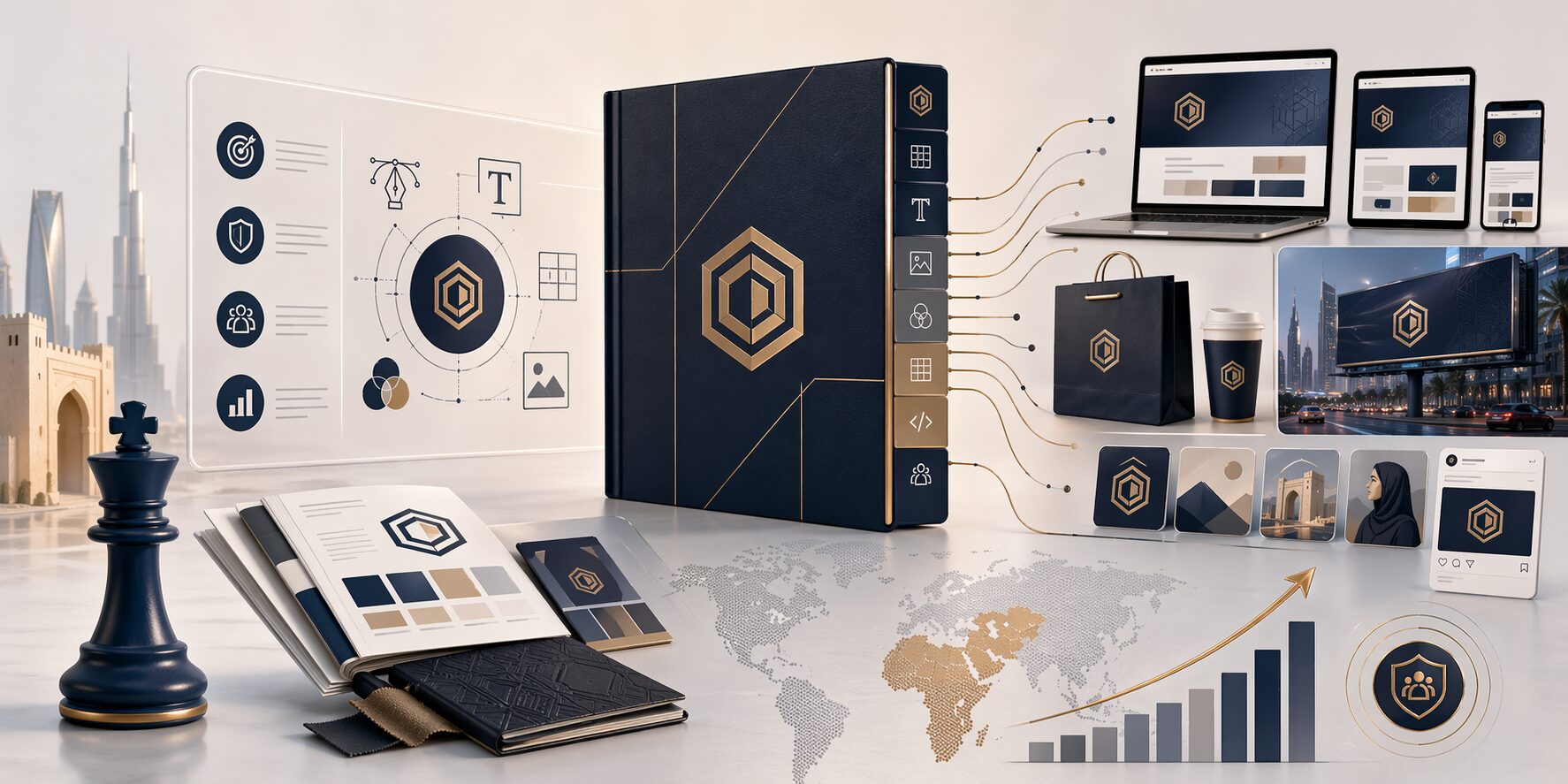
Rigorous ci manual design is not about logo clear space or color codes. It is about operational governance. It is the architectural blueprint that ensures your organization can scale into new markets, launch new products, and onboard new partners without diluting the equity you have spent millions building. When we audit enterprise organizations at Webkeyz, we rarely find a lack of creativity; we find a lack of coherence. The solution lies in treating your CI manual as a living system of control.
The Core Problem: The Fragmentation Trap
The moment an organization scales, entropy sets in. Marketing teams in different regions hire different local agencies. Product teams prioritize speed over alignment. Sales teams create their own slide decks. Without a centralized authority, your brand splinters into a dozen variations.
This fragmentation creates cognitive dissonance for the consumer. If your digital interface promises innovation but your physical collateral screams legacy bureaucracy, you have broken a promise. Trust erodes. Customer acquisition costs rise because you are effectively rebuilding recognition with every discordant interaction.
Effective ci manual design solves this by establishing a “single source of truth.” It removes subjectivity from the equation. It provides the framework that allows decentralized teams to move fast without breaking the brand. It shifts the conversation from “Does this look good?” to “Does this align with our governance?” templafy.
Hidden Killers: Why Most CI Manual Fail
If most companies have brand guidelines, why is inconsistency still rampant? The failure usually lies in the format and the philosophy of the manual itself.
The Static PDF in a Dynamic World
Traditional manuals are designed for print. They are static documents trying to govern dynamic, fluid environments like responsive web design and mobile applications. They fail to account for interaction states, accessibility standards, or cross-platform behavior. A manual that does not explicitly address digital experience is obsolete before it is distributed.
Absence of Strategic Context for CI Manual
Weak ci manual design focuses entirely on the “what” (pixels, hex codes, grids) and ignores the “why” (brand strategy, tone of voice, psychological impact). When vendors or employees don’t understand the strategy behind the rules, they find ways to bypass them.
Operational Friction
If your manual is hard to access, it will be ignored. If assets are buried in obscure folders, teams will grab low-resolution logos from Google Images. The modern CI manual must be a deployable toolkit often a cloud-based design system that integrates directly into the workflows of designers and developers.
The Methodology: Designing for Governance
To turn a CI manual from a reference document into a governance tool, you must adopt a systematic approach. This is not about restricting creativity; it is about defining the playground in which creativity creates value.
1. Modular Design Systems
We move beyond page-based guidelines to component-based systems. This borrows from software development principles. By defining the atomic elements of the brand—buttons, typography scales, iconography—we ensure that every digital product inherits the brand DNA automatically. This dramatically reduces technical debt and speeds up time-to-market.
2. Contextual Application Rules
Guidelines must dictate behavior, not just appearance. How does the brand behave in a crisis? How does the voice modulate between a recruitment ad and a shareholder report? Comprehensive ci manual design includes use-case scenarios that guide decision-making for non-designers.
3. Implementation and Training
A manual without adoption is shelf ware. The rollout requires internal marketing. This often involves training workshops where key stakeholders are coached on how to utilize the brand assets to achieve business goals. This connects directly to innovation training & coaching, ensuring that the internal culture is aligned with the external identity.
Proof & Outcomes: The Valuation of Consistency
The correlation between design governance and business performance is not theoretical. It is measurable.
According to McKinsey, companies that excel in design which includes the rigorous management of brand identity increase their revenues and shareholder returns at nearly twice the rate of their industry peers. This “design premium” is driven by the consistency of the user experience across all platforms.
Furthermore, research indicates that brand consistency is a direct revenue driver. Data suggests that consistent presentation of a brand across all platforms can increase revenue by up to 23%. In contrast, disjointed brand experiences contribute to customer churn. PwC notes that one in three customers will leave a brand they love after just one bad experience. Often, that “bad experience” is simply a disconnect in expectations a disjointed journey caused by poor identity management.
When ci manual design is executed correctly, it reduces operational costs. Marketing teams spend less time recreating assets. Development teams stop writing redundant code. The organization moves faster, with higher fidelity.
The MENA Perspective: Localization is Not Just Translation
In the Middle East and North Africa, the challenge of ci manual design is compounded by linguistic and cultural complexity. MENA is not a monolith, and a generic “Global” manual often fails when applied to the region.
The Typographic Challenge
Western CI manuals frequently specify typefaces that have poor or non-existent Arabic equivalents. Simply defaulting to a system font like Arial for the Arabic copy destroys the brand’s premium feel. webkeyz, being the region’s first UX and innovation agency, approaches this by selecting or designing Arabic typography that matches the optical weight and personality of the Latin counterpart. The manual must dictate how these scripts coexist how they align in bi-directional (LTR and RTL) interfaces.
Cultural Nuance in Imagery
Visual guidelines must navigate the diverse cultural landscape of the region. Imagery that resonates in Dubai might feel disconnected or inappropriate in Riyadh. A robust MENA-specific CI manual defines the nuances of photography, modesty, and lifestyle representation for specific local markets, ensuring the brand feels native, not imported.
Rapid Transformation
The MENA region, particularly KSA, is undergoing a speed of transformation that is globally unprecedented. Brands are launching and pivoting at breakneck speed to align with Vision 2030 initiatives. In this hyper-speed environment, a rigid, slow-moving manual is a liability. The guidelines must be agile enough to accommodate rapid digitization while holding the core identity firm.
Executive Takeaway For CI Manual
Your CI manual is either an accelerator or a bottleneck. If it is currently a PDF on a server that your product teams complain about, it is costing you money.
To correct this:
1. Audit the Current State: Review your last five major outputs (a campaign, an app update, a brochure, a pitch deck, a social post). Do they look like they came from the same company? If not, your governance has failed.
2. Digitize the Guidelines: Move from static PDFs to a web-based brand center or design system. Make access frictionless.
3. Mandate the Why: Ensure your ci manual design includes strategic reasoning, not just visual rules. Empower your teams to make decisions that align with the brand’s intent.
Closing
True brand authority requires discipline. If you are ready to transform your brand guidelines from a static document into a scalable operational asset, we should speak.
Contact webkeyz to discuss your brand infrastructure.