



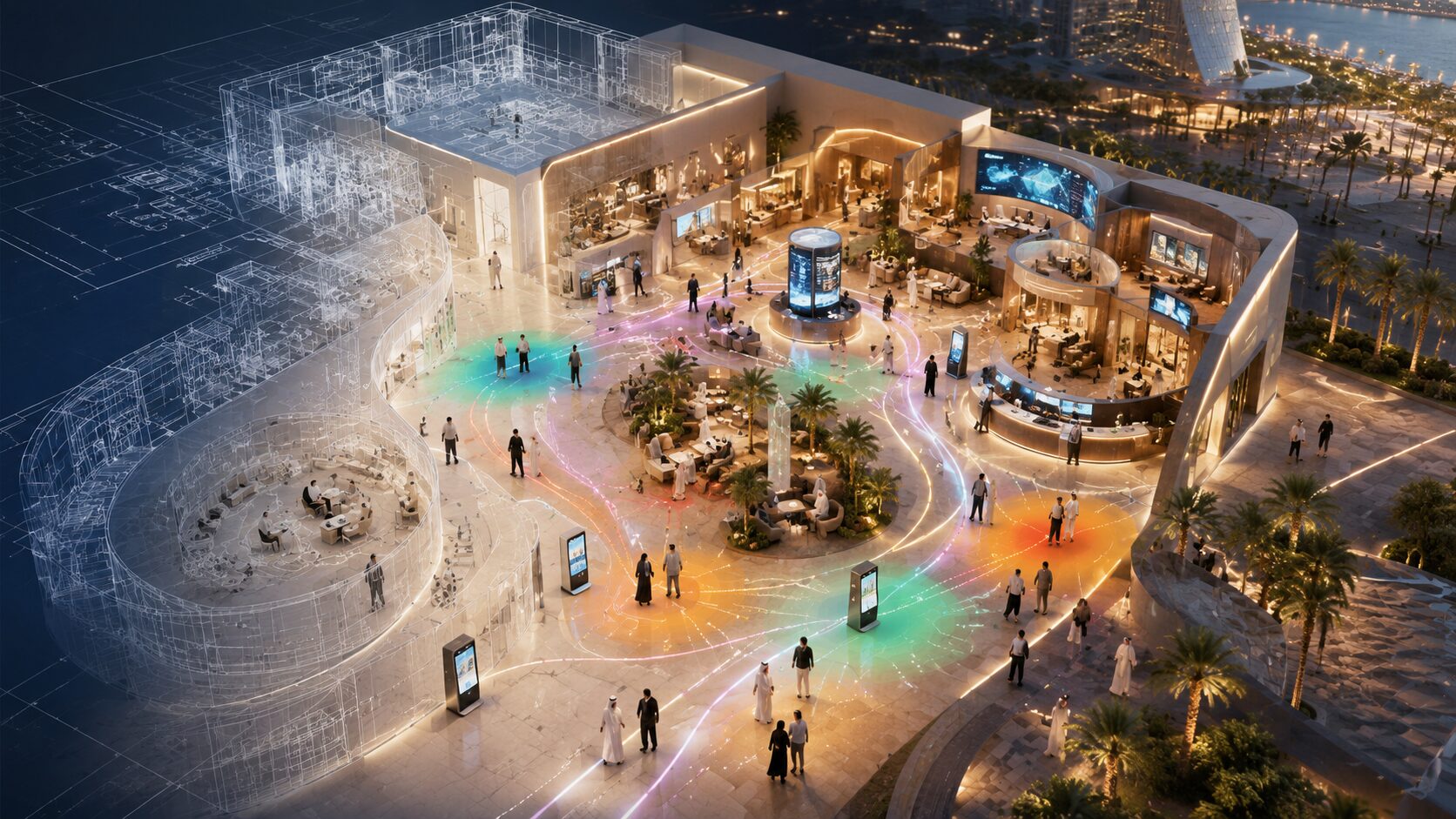
Executives sign off on billion-dollar real estate developments based on architectural renderings. They approve sweeping retail expansions based on footfall projections and geographic strategy. Yet, when the doors finally open, customers walk straight past high-margin product zones, employees struggle to collaborate in disjointed workspaces, and citizens face endless bottlenecks in service centers. The building functions structurally, but it fails behaviorally. This failure stems from a fundamental misunderstanding of space experience design.
Physical space represents one of the largest capital expenditures on any corporate balance sheet. Treating that space simply as a container for business operations guarantees suboptimal returns. Space must be treated as a dynamic user interface. Just as an executive would never launch a critical enterprise software platform without rigorous behavioral mapping and user testing, they must never launch a physical footprint without deploying space experience design. Every square meter must justify its existence by driving conversion, facilitating productivity, or reducing operational friction.
As MENA’s first UX Design and Innovation Agency, webkeyz recognizes a stark contrast between regional development and global legacy markets. While the US and European markets focus heavily on retrofitting aging infrastructure, the MENA region commands unprecedented greenfield development. Giga-projects, expansive retail networks, and modern civic hubs require a fundamentally different approach. In this high-stakes environment, space experience design acts as the critical bridge between architectural vision and measurable business reality.
The Massive Capital Risk of Ignoring Space Experience Design
Capital expenditure requires predictable returns. When leadership teams isolate physical development from human behavioral science, they introduce massive systemic risk into their portfolios. Ignoring space experience design creates stranded assets, physical environments that look spectacular in press releases but bleed operational capital day after day due to low adoption, poor navigation, and deep user friction.
Consider the reality of modern retail and corporate banking branches. Institutions pour tens of millions into modernizing their physical footprints to match their digital transformation narratives. They install massive screens, deploy tablet kiosks, and modernize the lighting. However, without rigorous space experience design, these technological additions become expensive clutter. Customers still queue in the wrong areas, staff still rely on manual workarounds, and the intended self-service zones remain abandoned. The investment yields zero lift in customer lifetime value because the physical journey was never aligned with human psychology.
In the MENA region, this risk compounds exponentially due to the sheer scale of ambition. The region is actively redefining the future of global urban living, tourism, and retail. Building a smart city or a mega-mall without integrating space experience design ensures that the infrastructure will struggle to engage its inhabitants. Beautiful spaces that cause cognitive overload, poor wayfinding, or physical exhaustion rapidly lose their premium status. When users cannot intuitively navigate a physical environment, they abandon it, taking their loyalty and their revenue with them.
Executive leadership must recognize that physical friction directly correlates to revenue loss. Every time a consumer cannot find a checkout, every time an employee must walk across a massive floorplate to conduct a simple collaborative task, and every time a citizen experiences confusion entering a government facility, the organization pays a quantifiable penalty. Space experience design eliminates these hidden taxes on your real estate investments by aligning the physical layout entirely with the required human outcomes.
Why Traditional Architecture Fails at Space Experience Design?
Architects are trained to master structure, safety, materials, and aesthetic impact. They excel at defining the physical limits of a building and ensuring it complies with zoning regulations and engineering standards. However, traditional architecture fundamentally fails at space experience design because it treats human beings as static variables in a spatial equation. Architects build for capacity; experience designers build for behavior.
This persistent problem originates in the traditional procurement and handover model. An executive team commissions a prestigious architectural firm to design a new corporate headquarters or flagship retail network. The firm delivers stunning blueprints optimized for natural light and structural elegance. Once the concrete cures, the architect steps away, leaving operations and marketing teams to figure out how actual humans will use the space. This massive handover gap is where space experience design is entirely lost.
Without space experience design, environments become visually impressive but behaviorally hostile. Traditional design processes rarely account for the cognitive load placed on a user entering a new environment. They do not rigorously map the transition zones where a customer steps out of the chaotic street and needs a moment of psychological decompression before they are ready to process marketing messages. When architecture operates in a vacuum, it fails to dictate the pace, flow, and emotional state of the user navigating the environment.
Furthermore, traditional architectural approaches struggle to integrate digital continuity. In the modern economy, physical spaces are no longer disconnected from digital ecosystems. A customer walks into a retail store with a mobile app open. A citizen enters a municipal building expecting their digital identity to sync instantly with physical service desks. When leadership relies solely on traditional building design, they create harsh borders between the digital and physical worlds. Space experience design dismantles those borders, treating the architecture and the digital overlay as a single, continuous user interface.
Operationalizing Space Experience Design Across Physical Portfolios
Transforming CapEx into high-performing assets requires leadership to operationalize space experience design systematically. It cannot be treated as a post-construction afterthought or a simple interior design exercise. It must be embedded directly into the project lifecycle, running parallel to structural engineering and architectural planning. To execute this, organizations must adopt a rigorous methodology that treats physical environments as testable, iterative products.
To operationalize this discipline, organizations must completely shift their approach to spatial planning. They must begin by defining the exact business outcomes required from the environment. Does the space need to increase average retail basket size? Does it need to accelerate the throughput of a service center? Does it need to maximize spontaneous collaboration among engineering teams? Once the business objective is locked, space experience design provides the exact behavioral blueprint to achieve it.
Mapping the Physical User Journey in Space Experience Design
The foundation of operationalizing this capability lies in mapping the physical user journey. Unlike digital journeys, which are bounded by screen dimensions and predictable click paths, physical journeys are entirely multidimensional. Space experience design requires analyzing the holistic sensory input a user experiences from the moment they approach the environment. This mapping accounts for sightlines, ambient noise, physical fatigue, and spatial orientation.
Effective space experience design categorizes physical environments into distinct behavioral zones. For example, the threshold of a building is mapped not just as an entrance, but as a decompression zone where no heavy decision-making should be required. Navigation corridors are mapped to reduce cognitive load, utilizing intuitive visual cues rather than relying entirely on heavy signage. High-value interaction zones, where revenue is generated or critical services are rendered, are mapped to eliminate all physical and digital distractions. By applying strict user experience research methodologies to these physical zones, webkeyz helps organizations transform chaotic floor plans into orchestrated engines of human interaction.
Integrating Digital Overlays in Space Experience Design
No modern physical environment operates entirely offline. The convergence of digital infrastructure and physical real estate is non-negotiable. Operationalizing space experience design requires seamless integration of these two domains. Executives must ensure that the transition between using a mobile application and interacting with a physical kiosk or human representative feels completely invisible to the end user.
When organizations deploy Spatial Experience Design effectively, they stop treating digital screens as physical posters. Instead, they use digital touchpoints to dynamically alter the physical environment based on real-time user needs. Wayfinding becomes personalized. Ambient lighting adjusts based on the time of day and the density of foot traffic. Digital queuing systems interact directly with the physical seating arrangements to reduce the anxiety of waiting.
Bridging the Digital Divide Through Space Experience Design
Bridging the gap between the screen and the room requires specific tactical execution. Space experience design maps the exact moments where a user must look down at their device and look up at their environment. If a retail customer must constantly shift their attention between a complex mobile app and confusing physical aisle signage, the cognitive friction forces them to abandon the purchase. The design must harmonize these inputs.
This harmonization is particularly critical in government and civic sectors. As MENA nations digitize their government services, the physical service centers must evolve to support citizens who still require in-person assistance. Deploying robust Citizen Experience Design within these physical hubs ensures that the architecture itself guides the citizen through a seamless hybrid process, significantly reducing operational costs while simultaneously increasing public trust and satisfaction.
How Space Experience Design Drives Measurable CapEx ROI?
Executives demand proof before altering established development pipelines. The shift toward experience-led physical environments is not driven by aesthetic preferences; it is driven entirely by measurable financial returns. When space experience design is executed correctly, it produces clear, quantifiable outcomes that directly impact the bottom line, from reduced employee turnover to massive gains in retail profitability.
The financial justification for integrating behavioral science into physical real estate is overwhelming. Unoptimized spaces bleed money through inefficiency, whereas optimized spaces actively generate value. In the retail sector, for instance, environments that successfully merge digital fluidity with physical intuition see direct increases in dwell time and conversion rates. Customers who feel psychologically comfortable and seamlessly guided through an environment spend substantially more capital than those fighting spatial friction. According to McKinsey, stores that aggressively bridge digital and physical boundaries to create intuitive environments can increase profitability and customer satisfaction significantly.
Similarly, in the corporate real estate sector, the impact of space experience design on human capital is profound. The design of an office environment directly dictates the cognitive performance, emotional well-being, and collaborative output of the workforce. Rigid, poorly designed floor plans stifle innovation and accelerate burnout. Conversely, intentional spatial design drives measurable performance improvements. Research from Gartner highlights that human-centric workplace design directly increases employee performance by 54%. When executives view their commercial leases through this lens, the ROI of optimizing the physical experience becomes undeniable.
Quantifying the Outcomes of Space Experience Design
To properly evaluate space experience design, leadership must expand their measurement frameworks beyond traditional real estate metrics like cost-per-square-foot or basic footfall sensors. These legacy metrics measure volume, not value. Measuring the true outcomes of a designed space requires tracking behavioral analytics and emotional resonance.
Customer loyalty is forged in physical environments. While digital transactions are efficient, physical interactions carry significant emotional weight. If a physical space causes frustration, the brand suffers immediate equity damage. However, when an environment anticipates user needs and removes physical friction, it creates deep emotional loyalty. As noted by PwC, 73% of consumers cite experience as a critical factor in their purchasing decisions. Furthermore, emotional connection drives distinct financial advantages. Research published by HBR demonstrates that customers who establish a positive emotional connection with a brand are 52% more valuable than those who are merely satisfied. Space experience design is the primary vehicle for manufacturing that emotional connection in the physical world.
By tracking spatial conversion rates, average dwell times, specific zone engagement metrics, and post-visit digital behavior, organizations can continuously iterate on their physical environments. Space experience design transforms static buildings into measurable performance marketing assets.
Mandating Space Experience Design at the Board Level
Real estate development and physical footprint strategy cannot remain siloed within facilities management or traditional procurement divisions. If an organization views physical space strictly through the lens of cost containment, it will inevitably build environments that fail its users. To extract maximum ROI from physical capital expenditures, the mandate for space experience design must originate at the board level.
Executives must change how they commission physical projects. They must stop approving architectural blueprints that lack a corresponding behavioral blueprint. When reviewing the rollout of a new retail network, corporate campus, or civic mega-project, leadership must demand clear answers on how the physical user journey has been mapped, tested, and optimized. They must require that space experience design leads the architectural brief, dictating form through the strict requirements of human function.
Furthermore, leadership must force collaboration across internal divisions. Space experience design requires the alignment of digital product owners, marketing executives, operations directors, and real estate managers. Creating a unified physical-digital ecosystem is impossible if these departments operate independently. The executive mandate must break down these silos, enforcing a single, unified vision for how users will experience the brand across every physical touchpoint.
In the rapidly expanding MENA market, the organizations that win will be those that realize physical scale alone is not a competitive advantage. Anyone can build a larger facility. The true competitive moat is built by those who master the human interaction within that facility. By committing to rigorous spatial strategy, executives ensure that every square meter of their real estate portfolio works relentlessly to drive their business objectives forward. Space experience design is no longer an optional luxury; it is the definitive framework for physical profitability.
To explore how webkeyz can align your physical CapEx directly with measurable behavioral outcomes, start the conversation with our design leadership today.